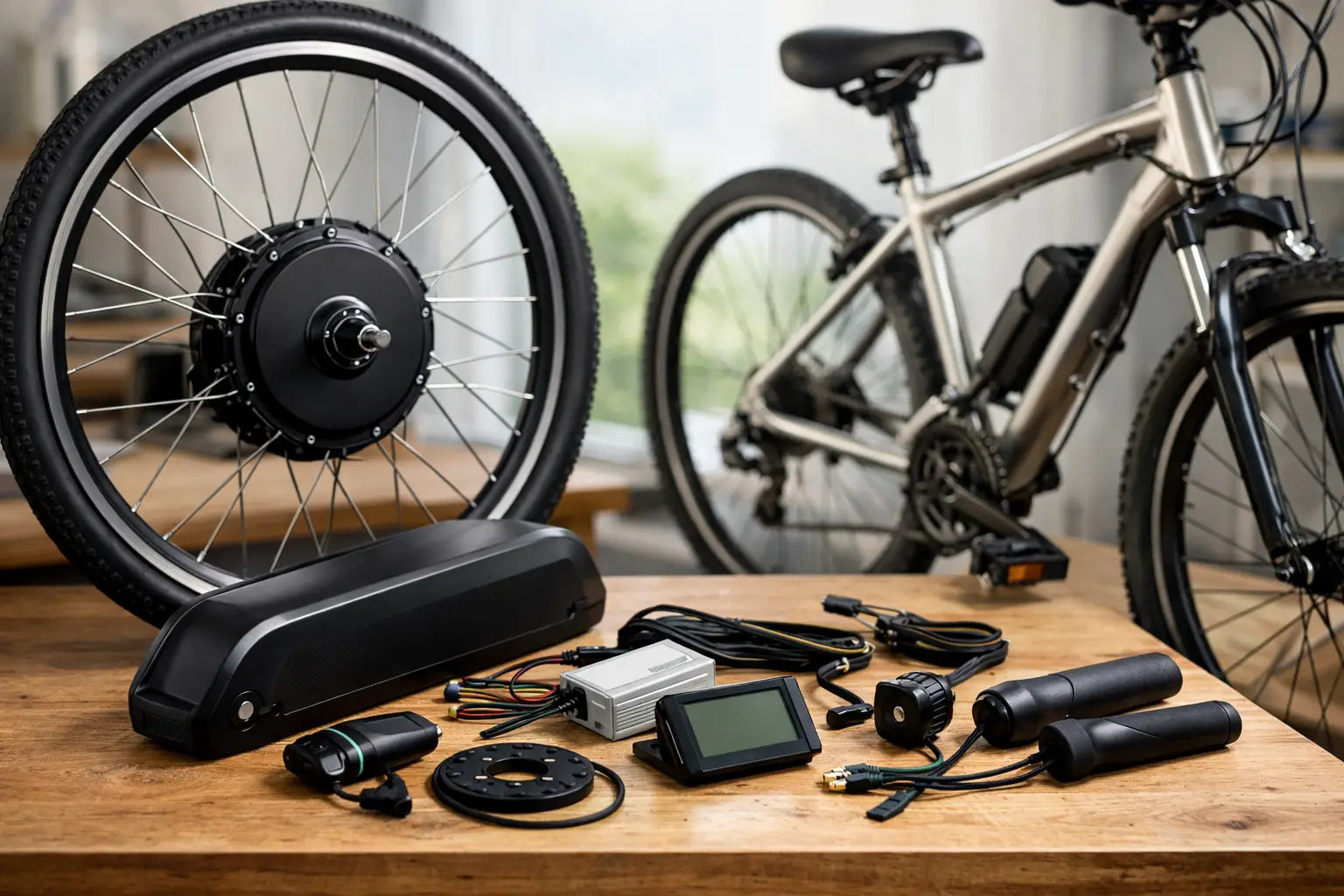
A bike that fits you well is worth keeping. If the frame is sound, the brakes are dependable and you enjoy riding it, electric assistance can turn familiar journeys into easier commutes, longer weekend rides and far less intimidating hills. But when riders ask, what's the best e bike conversion kit?, the honest answer is not one product name. The right kit is the one that matches your bike, riding style, budget and local e-bike rules without compromising safety or reliability.
A powerful motor is only part of the job. Battery quality, correct fitment, sensible gearing and professional set-up decide whether your converted bike feels like a useful everyday machine or a project that spends more time in the workshop than on the road.
What's the Best E Bike Conversion Kit? Start With Your Ride
Start with where and how you ride. A flat, short urban commute needs something very different from a loaded cargo bike tackling steep roads every day. It also matters whether you want gentle assistance that keeps cycling natural, or meaningful power for hills, headwinds and carrying kit.
Your existing bike is equally important. Check the frame condition, wheel size, axle type, brake mounts, drivetrain wear and, for mid-drive systems, the bottom-bracket shell. A conversion kit cannot make a cracked frame, tired chain or weak brakes safe. It will expose those problems faster because an electric motor adds torque, speed and weight.
For most riders who want a refined, capable conversion, a mid-drive kit is the strongest all-round choice. For straightforward, flatter riding on a tighter budget, a rear hub motor can be excellent. Front hub kits have their place, but demand extra care around fork strength, traction and torque arms.
Mid-Drive vs Hub Motor: The Decision That Matters Most
Mid-drive kits for hills, range and natural handling
A mid-drive motor sits at the bottom bracket and drives the chain through your bike's existing gears. That means you can select a lower gear for a climb, allowing the motor to work efficiently rather than labouring at low speed. The weight sits low and central too, which helps the bike retain predictable handling.
This is why systems from Bafang and Tongsheng or Varstrom are popular for riders who want proper hill-climbing support, mixed-terrain ability and a clean, purposeful conversion. A torque-sensing system can be especially satisfying: press harder on the pedals and the assistance responds in proportion, rather than simply switching on at a fixed level.
The trade-off is drivetrain wear. A mid-drive puts motor power through the chain, cassette and chainring, so worn components need replacing and shifting technique matters. Ease off the pedals briefly as you change gear, keep the chain clean and do not grind up steep climbs in the hardest gear. Done properly, it is a high-performing, serviceable set-up. Done badly, it can chew through a neglected drivetrain.
Rear hub kits for simple, practical assistance
A rear hub motor replaces the rear wheel or is built into a new wheel. It drives the wheel directly, so it does not load the chain and cassette in the same way as a mid-drive. For level commutes and leisure rides, that simplicity is appealing.
A good rear hub conversion is often quieter in day-to-day use and can be a sensible value option. It is particularly suitable for riders who want steady help on a mostly flat route, have a compatible frame and do not need to tackle repeated, very steep climbs.
The compromise is efficiency on hills. Because the motor cannot use your bike's gears, it can run hotter and draw more current when asked to pull hard at low speed. Rear-wheel removal can also be less convenient when fixing a puncture, especially where motor cables are involved.
Front hub kits are not a shortcut for every bike
A front hub kit can be easier to install and leaves the gears untouched. However, putting motor torque through a fork requires the right dropout design and correctly fitted torque arms. On wet surfaces or loose ground, a powered front wheel can also lose traction more readily.
They can work well on suitable bikes for modest assistance, but they are not the default recommendation for a high-power or high-mileage conversion. Safety and fit come first.
Choose Battery Capacity for Real Range, Not Wishful Thinking
The battery is the most expensive and safety-critical part of many conversion builds. Do not choose one purely because its advertised range looks impressive. Range varies with rider weight, hills, wind, tyre pressure, assistance level, temperature, cargo and how much you pedal.
Battery capacity is usually measured in watt-hours, calculated from volts multiplied by amp-hours. A 48V 15Ah battery stores 720Wh, for example. More watt-hours generally means more range, but it also means more weight and a higher price.
For a short commute with regular charging, a compact battery may be enough. For longer rides, frequent hills or all-day utility use, extra capacity gives useful breathing room and reduces the need to run the battery flat. Mounting position matters as well. A downtube battery usually provides the best balance and security, while a rear-rack battery can suit step-through frames but places more weight higher and further back.
Buy a properly specified battery with a quality battery-management system, matched charger and secure mounting hardware. Avoid damaged packs, unknown cells and improvised charging arrangements. Charge on a hard, clear surface, use the supplied charger and stop using a battery that is swollen, excessively hot, cracked or behaving unpredictably.
Power, Sensors and Legal Limits
More watts do not automatically make a better e-bike. A well-matched motor with smooth pedal assistance can feel quicker and more usable than an overpowered kit that overwhelms the tyres, brakes and frame.
Cadence sensors detect that the pedals are turning and apply assistance after a short delay. They are simple and effective for relaxed riding, but can feel more on-off. Torque sensors respond to pedal pressure, delivering a more intuitive ride and often better control when starting on hills or manoeuvring in traffic.
Check the rules where you ride before choosing a motor, throttle or controller. In Great Britain, electrically assisted pedal cycles have specific requirements around rated continuous power, pedal assistance and assisted speed. Other places apply different limits and classifications. A kit that is legal in one location may be treated as a moped or off-road-only machine elsewhere. Build for the riding you will actually do, not just the biggest number on a specification sheet.
Do Not Convert Until the Bike Is Ready
Electric assistance raises the standard required from the rest of the bike. Before fitting a kit, inspect the frame and fork for damage, make sure wheels are true and correctly tensioned, and check that tyres are in good condition and rated for the load and speeds involved.
Brakes deserve particular attention. Rim brakes must have healthy pads, clean rims and properly adjusted cables. Disc brakes need adequate pad life, aligned callipers and rotors in good condition. If your current brakes only just cope with the bike unassisted, upgrade or service them before adding a motor.
A fresh chain, correctly indexed gears and sound bearings make a conversion quieter and more efficient. If the bike has a poor-quality suspension fork, heavily worn wheel bearings or a corroded drivetrain, spend on the foundations first. The most satisfying e-bike conversions begin with a reliable bicycle.
The Best Kit Is One You Can Support
Consider the practicalities after installation. Can you source replacement brake pads, chains, spokes and tyres locally? Is the display readable in rain and low light? Can the motor settings be diagnosed and adjusted if something changes? Are wiring connectors protected and routed away from moving parts?
Established systems with sensible parts support are a better long-term investment than an anonymous bargain kit with no documentation, no spare parts and no one to call when a fault code appears. CAN Bus systems can offer cleaner communication between components, but compatibility still matters. A controller, display, battery and motor should be selected as a matched system, not assembled from random listings.
Professional installation also earns its keep. Correct torque settings, cable routing, brake cut-off set-up, battery security and a proper road test are the details that protect both rider and bike. The Bike Shack can help assess whether your existing bike is a good candidate, fit a suitable system and tune the finished build for the way you ride.
Choose the kit that makes you want to use your bike more often, then give it the same care you would give any dependable daily machine. Keep the drivetrain clean, check fasteners and tyre pressures regularly, and book a check-over after the first few rides. That is how electric assistance stays a genuine upgrade to your journey.