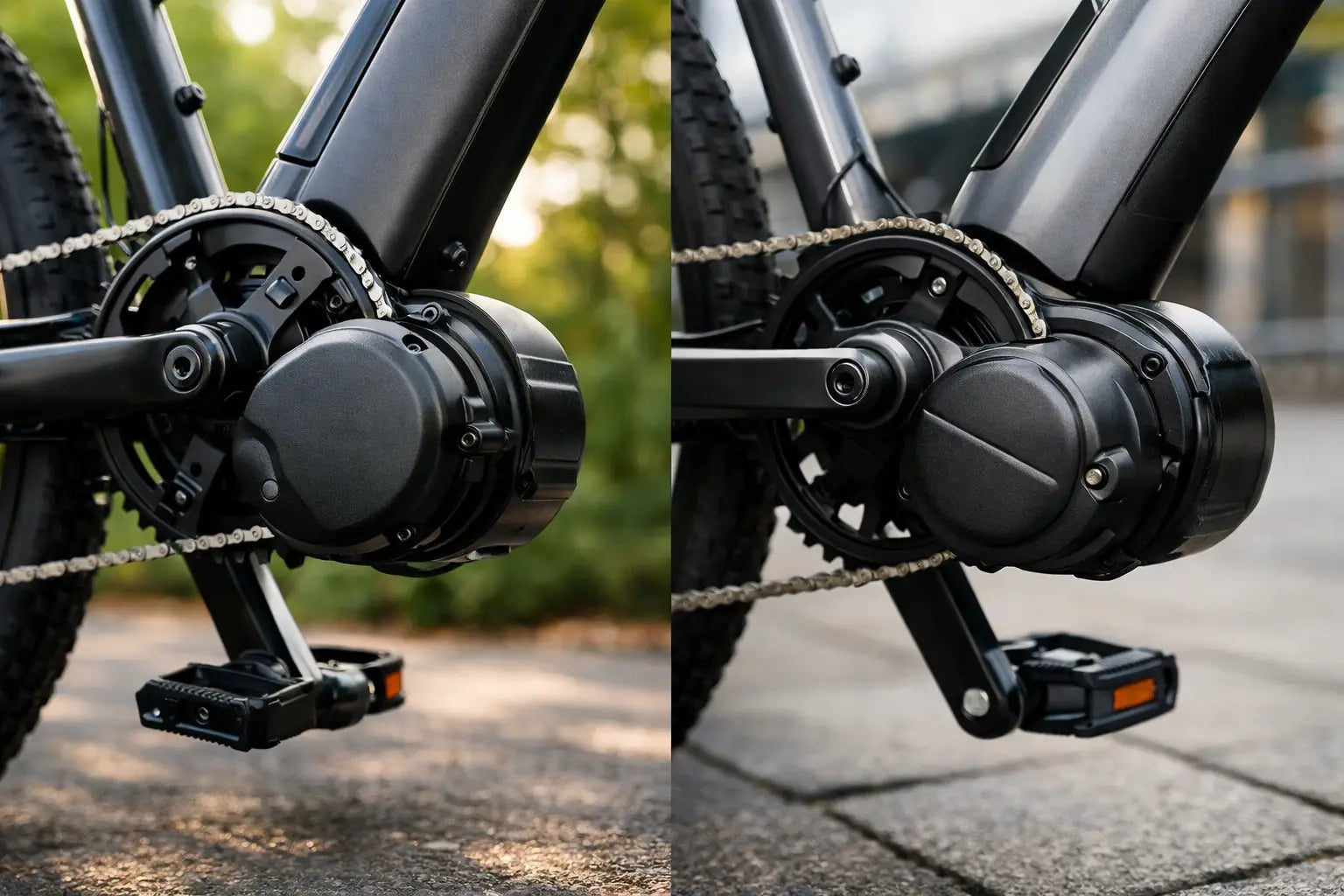
A conversion should make your existing bike more useful, not turn it into a constant workshop project. In the Bafang vs Tongsheng motors decision, the best choice comes down to how you ride, the hills you face, and whether you value outright pulling power or a more natural pedal feel.
Both brands have earned their place on converted commuter bikes, touring builds and practical everyday machines. Both are mid-drive systems, so they drive through your bike’s chain and gears rather than pushing from a wheel hub. That gives you strong climbing ability and efficient use of battery power, but it also means setup, gear choice and routine drivetrain care matter.
Bafang vs Tongsheng Motors: The Core Difference
The simplest way to separate these systems is by the way they respond to your pedalling. Most Bafang mid-drives use cadence sensing. Once the cranks are turning, the motor supplies assistance according to the selected level. It is direct, predictable and particularly effective when you want the motor to take a meaningful share of the work.
Tongsheng systems are best known for torque sensing. Rather than simply detecting that you are pedalling, the motor measures how hard you are pressing on the pedals and adjusts assistance accordingly. Press harder into a hill and it responds with more support. Ease back at a junction and the power reduces with you.
Neither approach is automatically better. A rider with a loaded pannier, a steep route and a desire to arrive without needing a shower may prefer the assertive support of a Bafang. A recreational rider who wants their familiar bike to retain its natural rhythm may find Tongsheng more rewarding.
Choose Bafang When Power Is the Priority
Bafang is a strong fit for riders who need practical assistance every day. Its mid-drive range is widely used because it delivers useful torque, works well with sensible gearing and has a broad ecosystem of compatible batteries, displays and workshop knowledge.
For commuting, Bafang’s cadence-led assistance can feel reassuringly decisive. Select a support level, begin pedalling and the motor gets on with the job. That helps when pulling away at lights, carrying shopping, climbing with a child seat, or tackling a route where the gradient seems to keep going.
A Bafang conversion also suits riders who want a clear difference between low and high assistance levels. Lower settings can stretch battery range on flatter roads, while the upper levels can take the sting out of a hard climb or a headwind. The riding feel is less subtle than torque sensing, but many people see that as a benefit. It is dependable, easy to understand and designed around getting you from A to B.
That said, strong assistance places demands on the rest of the bike. You need a healthy chain, correctly adjusted gears and brakes that are ready for the extra average speed a motor can bring. On a mid-drive, selecting an easier gear before a steep hill reduces strain on the chain, cassette and motor. Treat it like a car: do not labour it in too high a gear.
Where Bafang needs thought
The immediate power delivery can take a little getting used to in busy traffic, tight shared paths and low-speed manoeuvres. Good installation, sensible assist settings and smooth gear changes make a major difference. Some Bafang models and generations also use different control systems, so displays, programming options and replacement parts should always be selected for the exact motor rather than assumed to be interchangeable.
Choose Tongsheng for a More Natural Ride
A Tongsheng mid-drive is often the better match for riders who still want their legs to lead the ride. Its torque sensor makes assistance feel proportional to effort, so the bike encourages you to pedal with purpose rather than simply spin the cranks.
This can be excellent for leisure riding, fitness-minded commuting and mixed terrain. On a gentle road, light pressure gives light support. When the road rises, your increased effort prompts the motor to help more. The result can feel closer to riding a very good day on your normal bike, only with stronger legs when you need them.
Tongsheng is also a sensible option for cyclists who dislike the on-off sensation sometimes associated with cadence sensing. The power delivery is typically more progressive, which can make starts and slow technical sections feel controlled. For riders returning to cycling after injury or building confidence on an e-bike, that measured response can be particularly appealing.
The trade-off is that torque-sensing assistance asks for input. It rewards a rider who is willing to work with the system. If your main goal is minimal effort on punishing hills or heavily loaded journeys, a more forceful Bafang setup may feel better suited to the task.
Where Tongsheng needs thought
A torque sensor needs accurate installation and calibration to deliver the smooth response riders expect. The bike’s gearing still matters, and the system will not compensate for a worn drivetrain or poor shifting. It is also worth considering the availability of the exact motor, display and controller combination you plan to run. A conversion is easier to support long-term when its components are known, compatible and properly fitted from the start.
Motor Power Is Only Part of the Picture
It is tempting to compare motor wattage and stop there. In real riding, battery capacity, rider weight, tyre pressure, terrain, gearing and assist level all influence how a converted bike feels. A well-matched 250W road-legal system with the right gears can be more useful than a higher-powered setup that is poorly installed or constantly run in the wrong ratio.
For public-road use in Great Britain, an electrically assisted pedal cycle must meet the relevant legal requirements. As a general guide, pedal assistance must cut out at 15.5mph and the motor’s maximum continuous rated power must not exceed 250W. The bike must also be pedal-assisted rather than operating as an unrestricted electric motorcycle. Throttle arrangements and modified systems can change the legal classification, so check the current rules before buying or altering a kit.
This is not just paperwork. A compliant, professionally set-up conversion is easier to use with confidence on the road, easier to insure where required, and more straightforward to maintain as a practical transport bike.
Battery and Gearing Make the Motor Work Better
Whether you choose Bafang or Tongsheng, do not treat the battery as an afterthought. Battery capacity is measured in watt-hours, and more watt-hours generally mean more potential range. But a large battery is not automatically the right answer if it makes the bike awkward to lift, poorly balanced or unsuitable for the frame.
Think about your genuine weekly riding. A short, mostly flat commute needs something different from a long hilly route with panniers. Cold weather, repeated climbs and high assistance settings all reduce range, so leave a sensible margin rather than planning every journey around the claimed maximum distance.
Gearing is equally important. Mid-drive motors benefit from being able to spin efficiently, so a wide-range cassette or appropriate internal hub gears can transform hill performance. A worn chain and sprockets should be replaced before or during the conversion, not after the motor exposes every weak point in the drivetrain.
Servicing: The Difference You Feel After Six Months
The most successful e-bike conversions are built around the whole bicycle. Before fitting a motor, check the frame condition, wheel strength, tyre condition, brake performance, headset bearings and chain wear. A motor will not fix loose spokes, contaminated brake pads or a slipping chain. It will make those problems more urgent.
Bafang’s widespread use can make it a practical choice for riders who want familiar parts and established servicing procedures. Tongsheng appeals to riders who prioritise its torque-sensing feel, provided the kit is specified carefully and supported properly. In both cases, regular chain cleaning, lubrication, gear adjustment and brake checks are the best protection for your investment.
At The Bike Shack, we look at the bike and the rider together: intended mileage, storage, hills, payload, comfort and maintenance expectations. That avoids the common mistake of fitting a powerful kit to a bike that needs basic mechanical work first.
Which Motor Should You Fit?
Choose Bafang if you want confident, straightforward assistance for commuting, cargo, steep hills and getting more journeys done with less effort. It is the practical workhorse option, especially when you appreciate firm support and clearly defined assist levels.
Choose Tongsheng if you want assistance that closely follows your own effort and preserves a traditional pedalling character. It is particularly compelling for recreational riders, fitness-focused cyclists and anyone who values smooth, intuitive modulation of power.
The right motor is the one that makes you choose the bike more often. Start with your route, make sure the bicycle is mechanically ready, and build the conversion around reliable braking, sensible gears and a battery you can depend on.