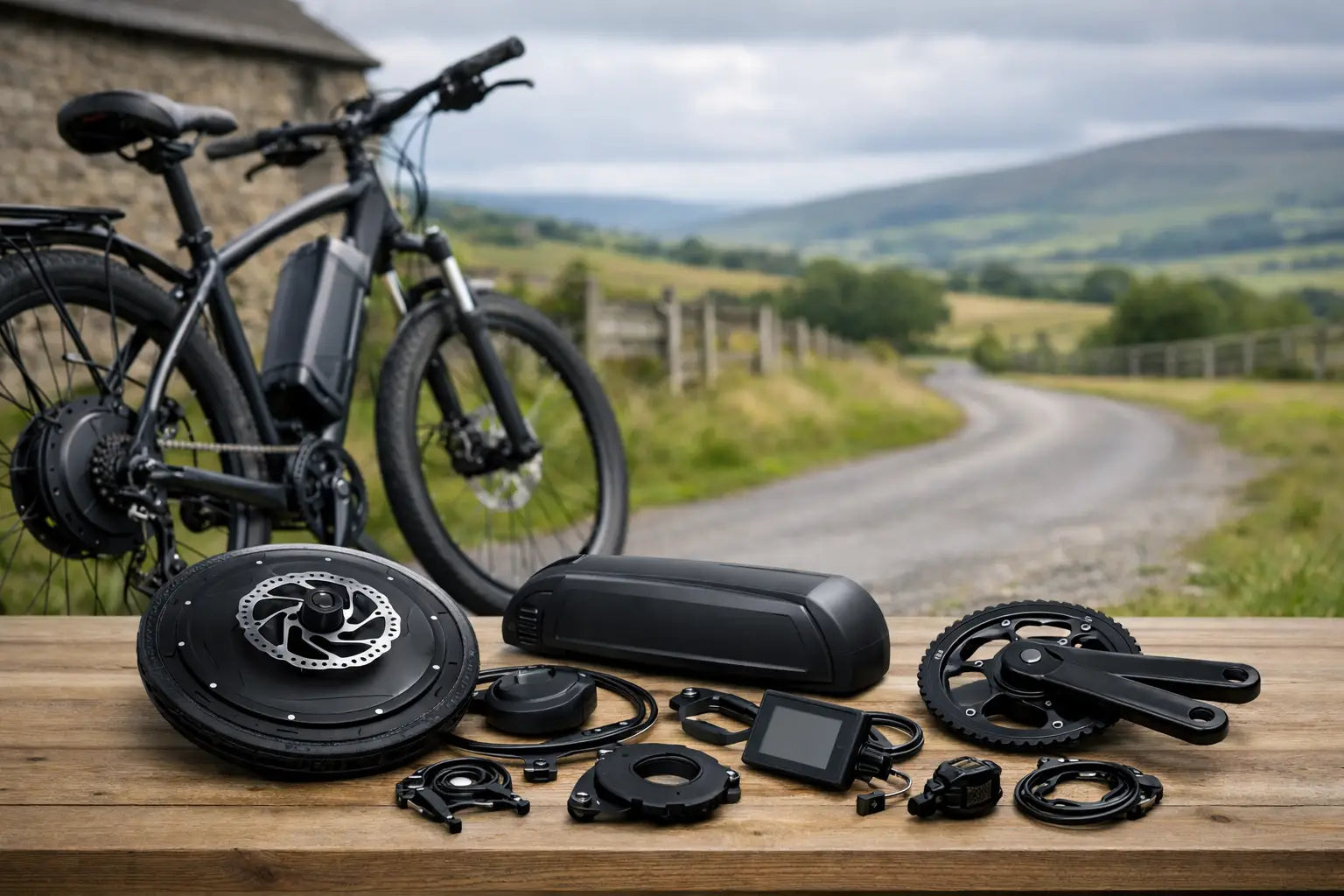
A bike that already fits you well is often the best starting point for electric assistance. The best e-bike conversion kits do not simply add speed. They make steep commutes manageable, extend your range, and help you arrive fresher without giving up the bike you know.
The right kit depends on where and how you ride. A flat town commute asks different questions from a hilly weekend route, a cargo setup, or a long ride with a child seat. Motor position, battery capacity, drivetrain condition and legal compliance all matter. Get those details right and a conversion can feel like a properly integrated e-bike rather than a bike carrying extra hardware.
What makes the best e-bike conversion kits?
A good conversion starts with a sound bicycle. Before fitting a motor, check the basics: brakes must stop confidently, wheels must be true and properly tensioned, bearings should run smoothly, and the chain, cassette and chainrings should not be worn out. Electric assistance increases the load on these parts, particularly when climbing or starting under power.
The kit itself needs to match the job. For most UK road use, the system should be configured to meet Electrically Assisted Pedal Cycle requirements: pedal assistance, a maximum continuous rated motor power of 250 watts, and assistance that cuts out at 15.5 mph. Rules can be more complicated for throttles and higher-powered systems, so do not assume every kit sold online is suitable for ordinary public-road and cycle-path use.
A quality kit also gives you useful support after installation. That means clear diagnostics, available replacement parts, compatible displays and sensors, and someone who can set up the system correctly. The cheapest box on the internet is rarely the cheapest route once you add a poor battery, awkward fitting, worn drivetrain parts and no help when a fault code appears.
Hub motor or mid-drive: choose for your route
Hub motors suit simple, flatter riding
A hub motor sits in the centre of the front or rear wheel. Rear-hub kits are a popular choice for commuting and leisure riding because they deliver a steady push with relatively little disruption to the bike's original drivetrain. They can be an effective option for flatter routes, moderate distances and riders who want a straightforward conversion.
There are trade-offs. A hub motor adds weight to the wheel, making puncture repairs and wheel work more involved. On long, steep hills, it cannot use the bike's gears as effectively as a mid-drive. The wheel must also be built or supplied to a standard that can handle the added torque. A weak rim, loose spokes or unsuitable dropouts can turn an affordable conversion into a reliability problem.
Mid-drive kits make better use of your gears
A mid-drive motor replaces the bottom-bracket area and drives the chainring. Systems from established names such as Bafang and Tongsheng/Varstrom are popular because they keep the weight low and central, where it has less effect on handling. More importantly, they use your bicycle's gears.
That matters on hills. Shift down as you would on a normal bike and the motor can spin efficiently rather than labouring in a high gear. For riders tackling frequent climbs, carrying panniers, or covering mixed terrain, a mid-drive is usually the more natural and capable choice.
The compromise is drivetrain wear. The chain, cassette and gear cables need to be in good order, and the rider needs to ease off slightly while shifting rather than changing gear under full motor load. A torque-sensing system can feel especially refined because assistance responds to how hard you pedal. Cadence-sensing systems are often more affordable and can deliver stronger assistance with less rider input, but the feel can be less subtle.
Battery capacity determines the rides you can make
Motor wattage gets attention, but the battery decides much of the real-world experience. Battery energy is measured in watt-hours, calculated by multiplying voltage by amp-hours. A 36V 14Ah battery, for example, provides roughly 504Wh of energy.
There is no honest single range figure. Wind, hills, rider weight, tyre pressure, cargo, temperature, assist level and how often you stop all affect it. As a practical guide, a 400Wh to 500Wh battery suits many everyday commutes and local rides, while 600Wh and above offers more confidence for longer or hillier journeys. Use a larger battery if you regularly ride in higher assistance modes or cannot charge at your destination.
Battery mounting is just as important. A down-tube battery keeps weight central and is usually the neatest option, but frame shape, bottle-cage mounts and suspension linkage can limit space. Rear-rack batteries can work well on some bikes, although they shift weight rearwards and may conflict with luggage plans. Measure before ordering, including room to slide the battery off its rail for charging.
Buy for battery quality, not just capacity. A properly specified battery management system, secure casing, correct charger and sensible storage habits protect both performance and safety. Avoid damaged packs, unbranded cells and improvised wiring. If a battery becomes unusually hot, swells, smells odd or has been badly damaged in a crash, stop using it and seek professional advice.
Check your bike is a sensible conversion candidate
Many hybrid, hardtail mountain and commuter bikes convert very well. They have practical frame layouts, dependable brakes and room for a battery. Some bikes need closer assessment before any parts are ordered.
Carbon frames require particular care because motor mounts and battery brackets can place loads where the frame was not designed for them. Full-suspension bikes can be difficult because battery space is limited and rear-suspension movement complicates cable routing. Very old bicycles may need upgrades to wheels, brakes or gearing before they are ready for electric assistance.
Disc brakes are not compulsory, but strong, well-maintained brakes are essential. If your bike has rim brakes, good pads, clean rims and correctly adjusted cables become even more important. For any conversion, inspect tyres, spoke tension, headset bearings and the condition of the frame and forks. Power is only useful when the whole bike remains predictable and safe.
The best kit is not always the most powerful one
More power can sound tempting, especially when a route includes hills. But a legal, well-geared system with the right battery often feels better in daily use than a high-output setup that is heavy, hard on components or unsuitable for public-road use.
Think about the outcome you want. If you want to reduce effort on a five-mile commute, smooth assistance and quick charging may matter more than maximum torque. If you live at the top of a long climb, a mid-drive paired with lower gears is likely to give better results. If you carry shopping, tools or a child trailer, stability, braking and battery capacity deserve priority over headline figures.
This is also where professional fitting earns its place. Motor mounting torque, cable routing, brake cut-off settings, speed-sensor alignment and display configuration all affect the way a conversion rides. A workshop can also spot incompatibilities before they become expensive: a bottom bracket that will not accept the selected mid-drive, a frame with insufficient battery clearance, or a worn cassette that will skip under motor load.
A practical buying checklist
Before choosing a kit, confirm these five points:
- Your bike's frame material, bottom-bracket type, wheel size and dropout condition.
- Whether your typical route is flat, rolling or consistently steep.
- The battery size you need based on charging opportunities and real riding distance.
- That the chosen setup can meet UK EAPC rules for the way you intend to use it.
- Who will install, inspect, tune and support the system after purchase.
Keep a converted e-bike performing properly
An electric conversion needs routine care, particularly around the drivetrain. Clean and lubricate the chain regularly, check for chain stretch, and deal with slipping gears early. Mid-drives place more force through the chain and cassette, so timely replacement is cheaper than waiting for several parts to wear out together.
Check spoke tension and wheel trueness periodically, especially with hub motors. Keep tyres inflated to the correct pressure, inspect brake pads for wear, and make sure all motor and battery connections are clean, dry and fully seated. Charge the battery with its supplied charger in a dry, ventilated area, away from exits and combustible materials.
The most satisfying conversion is the one you stop thinking about because it simply works. Choose a kit that suits your route, fit it to a bike worth keeping, and give the whole system the same care you would expect from any dependable daily machine. Then every hill becomes a little less of a negotiation.