A steep hill on the way home can turn a bike you love into a bike that stays in the shed. Electric bikes change that calculation. They add assistance when you need it, helping you arrive less sweaty, carry more, ride farther and keep cycling when headwinds, hills or tired legs would normally win.
But the right e-bike is not simply the one with the biggest battery or the highest wattage on its box. For many riders, the best answer is a properly chosen conversion on a bike they already know and trust. For others, a purpose-built electric bike offers the better starting point. The difference comes down to how you ride, what your current bike is capable of, and whether it can be maintained properly for the miles ahead.
What electric bikes actually do
An e-bike motor supports your pedalling rather than replacing it. Pedal-assist sensors detect movement, pedal force, or both, then supply power from the battery to make each turn of the cranks easier. You still choose the pace, the gear and the effort. The assistance simply reduces the penalty of a climb, a loaded pannier or a long commute.
That makes electric bikes useful for far more than fast journeys. They can help a returning rider build confidence, let couples with different fitness levels ride together, and make everyday errands realistic without reaching for the car. Lower assistance can still feel like normal cycling, only with the hard edges taken off. Higher modes are there for tough gradients, heavy loads and days when getting home matters more than training.
In Great Britain, a road-legal electrically assisted pedal cycle, or EAPC, must have pedals, a motor with a maximum continuous rated power of 250 watts, and assistance that cuts out at 15.5 mph. Riders must be at least 14. A conversion kit can meet those rules, but the specification and installation matter. Do not assume every motor, throttle or imported kit is legal for public-road use.
Buy a new e-bike or convert the bike you own?
A new e-bike is often the straightforward route. The frame, wheels, brakes, battery position and electrical system have been designed as one package. It can be a strong choice if you need a cargo bike, want a low-step frame, are replacing a worn-out bike, or want manufacturer-designed integration from day one.
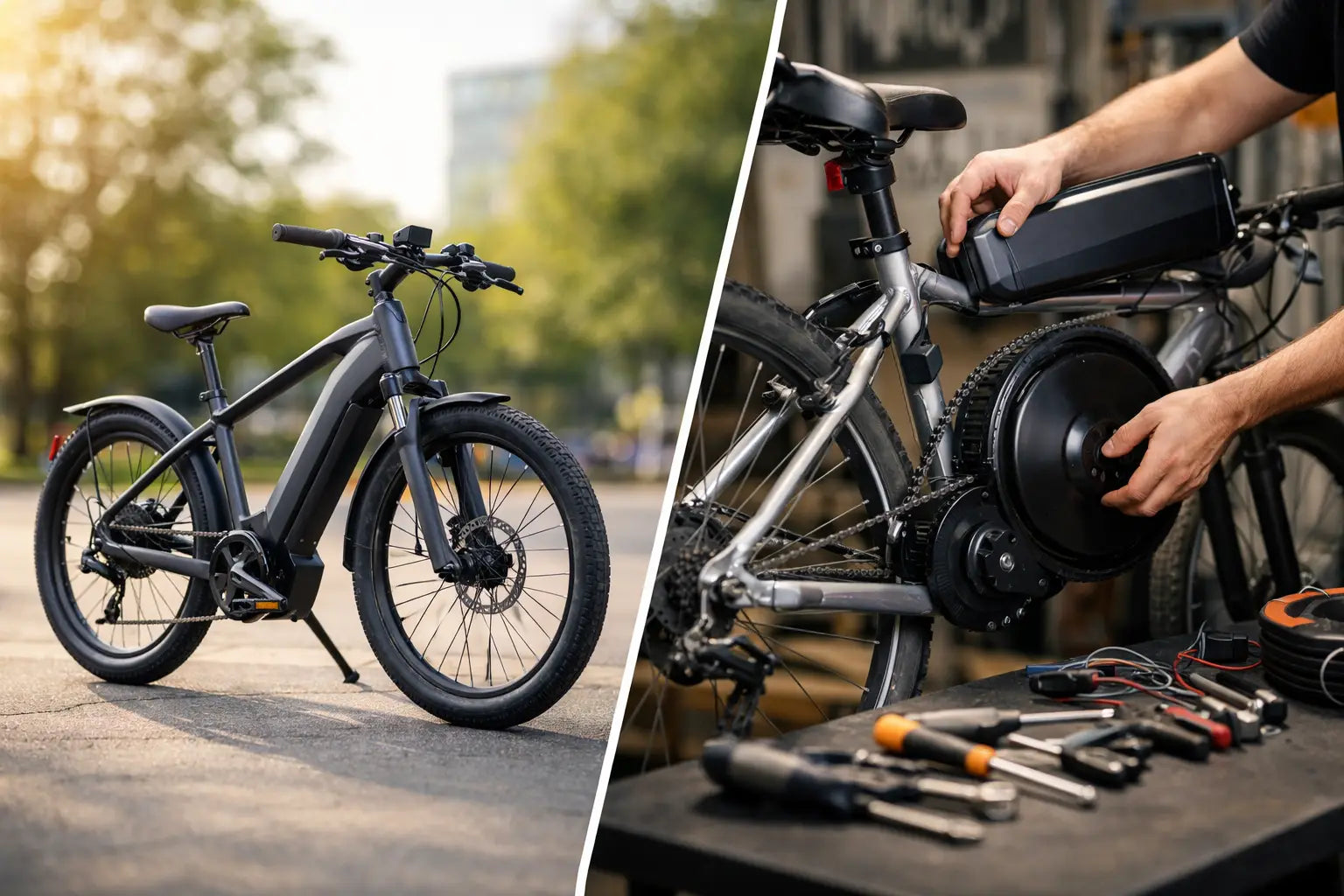
A conversion is compelling when your existing bike fits perfectly and has a sound foundation. Perhaps it has a frame you enjoy, a comfortable riding position, quality wheels or a history with you. Replacing it purely to gain assistance can be unnecessary. A well-planned conversion can retain the bike’s character while adding the range and hill-climbing ability that changes how often you use it.
The trade-off is that not every bike is a suitable conversion candidate. A workshop should inspect the frame, fork, dropouts, drivetrain, brakes and wheels before a motor goes near it. An older bike with tired hubs, worn chainrings and weak brakes may need more than a kit. Spending on the basics first is not an upsell. It is what makes the finished bike safe, predictable and worth riding.
Why mid-drive systems suit everyday riders
For many conversions, a mid-drive motor is the practical option. It sits around the bottom bracket and drives through the bike’s gears. That means you can select a low gear for a climb and let the motor work efficiently, much like choosing the right gear in a car.
Mid-drives from established systems such as Bafang and Tongsheng or Varstrom can offer strong hill performance, natural assistance and a tidy weight distribution near the centre of the bike. They are particularly well suited to commuters, touring riders and anyone facing repeated gradients.
There is a maintenance consideration. Because a mid-drive puts power through the chain, cassette and chainring, worn drivetrain parts will show their age quickly. Good shifting technique matters too: ease off pedal pressure briefly when changing gear instead of forcing a shift under full motor load. Treat the drivetrain well and it will reward you with quieter, smoother miles.
Hub motors have their place, especially for flatter routes and simpler builds, but they do not use the bike’s gears in the same way. The best system depends on the route, bike type, rider weight, load, budget and the feel you want from the assistance.
Start with the route, not the specification sheet
Battery capacity is usually expressed in watt-hours, or Wh. More watt-hours generally means more range, but no honest workshop can promise an exact mileage without knowing the rider and route. A light rider on flatter roads in low assistance will travel much farther than a heavily loaded rider using maximum power into a cold headwind.
Think about the journey you need to make regularly. A short urban commute with reliable charging at both ends needs a different setup from weekend rides through hilly countryside. If you want to tow a child trailer, carry shopping or ride year-round, factor in the extra demand. It is better to choose enough battery for your real routine with a sensible reserve than to chase the biggest possible pack and carry unnecessary weight.
Motor power also needs context. More torque can make climbs easier, but traction, gearing, tyre condition and rider control still matter. A powerful system paired with poor brakes, a stretched chain and unsuitable tyres is not a performance upgrade. It is a reliability problem waiting for a wet morning.
Reliability begins before the motor is fitted
An electric conversion adds weight, speed potential and load to a bicycle. That is why the foundation matters. Brakes should be correctly adjusted with healthy pads, discs or rims in good condition, and cables or hydraulic systems working as intended. Wheels need to be true, spokes properly tensioned and tyres in good condition. The drivetrain should shift cleanly across the full gear range.
Pay attention to contact points as well. A small adjustment to saddle height, handlebar position or grips can make an e-bike far more comfortable, especially when you begin riding longer and more often. Mudguards, lights, a secure rack and puncture-resistant tyres may do more for everyday use than another flashy component.
Professional fitting and testing are worth it for a conversion. The motor must be installed to the correct specification, cables routed safely, fasteners checked, firmware and display settings configured appropriately, and the bike test-ridden under load. A good installer will also explain charging, gear use, fault finding and the service intervals that keep the system working properly.
At The Bike Shack, that workshop-first approach means the conversion and the bike around it are treated as one machine, not a box of parts bolted together.
Battery care that protects your investment
The battery is the most valuable consumable part of most electric bikes. It deserves more attention than simply plugging it in after every ride. Use the supplied or approved charger, keep terminals clean and dry, and charge on a hard, non-flammable surface where you can keep an eye on it.
Avoid leaving the battery in extreme heat or freezing conditions. If the bike will not be ridden for several weeks, store the battery indoors at a partial charge rather than fully empty or permanently at 100 per cent. Let a battery that has been used in very cold weather warm up indoors before charging.
A removable battery also brings practical benefits for commuters. You can charge it at home or work, reduce the weight when lifting the bike, and avoid leaving the most expensive electrical component exposed on a public rack. Always lock the bike properly, even if the battery is removed.
Keep your e-bike riding like an e-bike
Electric assistance can hide developing mechanical issues until they become expensive ones. Make a quick check part of your routine: tyre pressure, brake feel, chain lubrication, secure battery mounting and any unusual noises. If the bike starts clicking under load, shifting poorly or pulling to one side when braking, book it in before a small adjustment becomes a failed part.
Regular servicing is especially useful for high-mileage commuters. A technician can check spoke tension, wheel alignment, brake wear, drivetrain wear, electrical connections and motor mounting points. This is not about over-servicing. It is about protecting the safety and dependable performance that made you choose electric assistance in the first place.
The best e-bike should make your next ride feel possible, whether that is a five-mile commute, a loaded trip to the shops or a climb you have avoided for years. Choose a legal, well-supported system, maintain the bike beneath it, and let the extra power give you more reasons to ride.