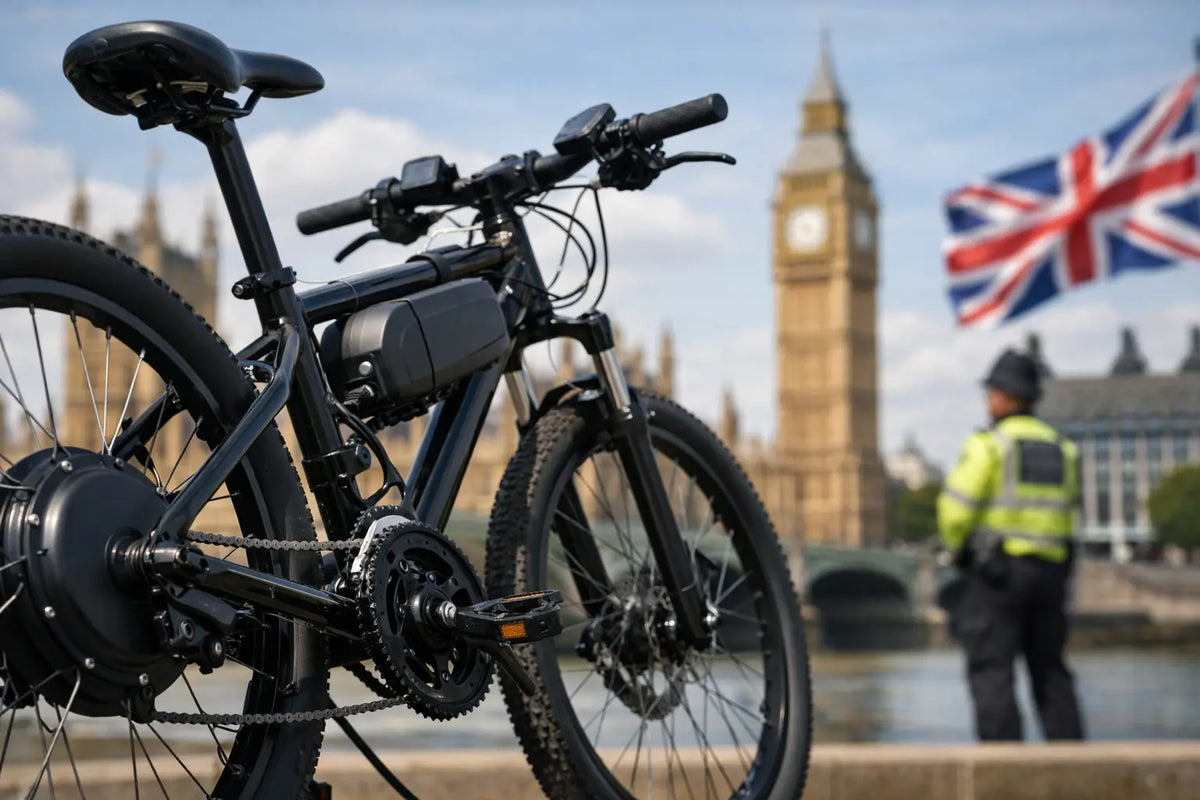
A conversion kit can turn a trusted commuter, folder or mountain bike into a genuinely useful e-bike. But e-bike kit legality is not decided by how powerful the bike feels, what the seller calls it, or whether it has pedals fitted. For a conversion to be ridden on public roads and cycle routes in Great Britain without vehicle registration, tax or a driving licence, the finished bike must meet the legal definition of an Electrically Assisted Pedal Cycle, usually shortened to EAPC.
That distinction matters. A properly specified EAPC can be a brilliant everyday machine: practical on hills, cheaper to run than a car for short journeys, and still treated as a bicycle in most situations. A build that falls outside the rules may be classed as a motor vehicle instead. That can bring requirements for registration, insurance, an approved helmet, a licence and vehicle approval that a home-built conversion may struggle to meet.
E-Bike Kit Legality: The EAPC Rules
For most adult riders, the key rules are straightforward. An EAPC must have pedals that can propel it. The motor's maximum continuous rated power must not exceed 250 watts, and motor assistance must cut out when the bike reaches 15.5 mph, or 25 km/h.
The phrase “maximum continuous rated power” causes plenty of confusion. It is not necessarily the same as the highest wattage shown on a display when pulling away or climbing a steep hill. Some systems produce a higher short-term peak output while remaining rated at 250W continuous. What matters is the motor's genuine continuous rating, its documentation and the way the complete system is configured.
The assistance must also stop at the legal speed. The rider can still pedal faster than 15.5 mph under their own effort or while going downhill. The rule is about motor assistance, not a speed limit for the bicycle itself. If the motor continues to push beyond that point, the bike is no longer operating as a standard EAPC.
A compliant EAPC can be ridden by anyone aged 14 or over in Great Britain. There is no legal requirement for a helmet, insurance, vehicle tax, registration or a driving licence, although a well-fitted cycle helmet and suitable insurance remain sensible choices for regular riding.
The rules apply to the finished bike
A kit may be advertised as “250W legal”, but that is only part of the picture. The controller, display, speed sensor, throttle settings and motor all influence compliance. A 250W motor paired with a controller that allows assistance beyond 15.5 mph is not a compliant road-going EAPC setup.
This is why a conversion should be planned as a system, not bought as a collection of individual parts. Keep the motor specification, battery details, purchase records and configuration information. If you ever need to demonstrate what your bike is, clear paperwork is far more useful than a verbal assurance.
Throttles Need Extra Care
Throttle-equipped conversions are where legal advice often becomes vague. A throttle that powers the bike without pedalling is not automatically permitted on a modern EAPC.
In Great Britain, a throttle can generally provide assistance up to 6 km/h without pedalling as a walk-assist or start-assist function. Beyond that speed, a throttle-only system introduced to the market after 1 January 2016 normally needs type approval to be used lawfully as an EAPC. Pedal-assist operation remains the simplest route for a road-legal conversion.
There are older throttle e-bikes and particular type-approved models with different status, so date and approval history matter. Do not assume that a twist grip on an imported kit is legal simply because it is common elsewhere. If road use is the goal, choose a pedal-assistance system with a correctly limited walk-assist function, or obtain clear written evidence of the relevant approval for any throttle arrangement.
What Makes a Conversion Non-Compliant?
The most common problem is not poor workmanship. It is a setting changed in the name of extra speed. Many displays and controller apps allow parameters to be adjusted, including wheel size, speed limit and current limit. A wheel-size setting that is wrong can make the system misread speed. A raised speed limit can remove EAPC status in seconds.
Derestriction devices are another clear risk. If a dongle, altered sensor signal or software setting lets the motor assist past 15.5 mph, it should not be used on public roads, cycle tracks or other public places. Calling it “off-road mode” does not make it suitable for the school run, a canal path or a commute.
Motor power also deserves an honest look. A 500W, 750W or 1,000W kit may offer impressive acceleration and hill climbing, but it is not a standard EAPC conversion for public-road use in Great Britain. It may have a place on genuinely private land with the landowner's permission, but private use does not grant a free pass to ride it anywhere else.
If a converted bike is treated as a motor vehicle, the practical route to legal road use can be difficult. Registration, insurance and type approval requirements may apply, and not every modified bicycle can meet them. Building within EAPC limits from the start is usually the safer, simpler and better-value decision.
Build for Safe, Reliable Assistance
Legal motor output is only one part of a responsible conversion. Adding electric assistance increases the loads on the drivetrain, wheels, tyres and brakes, particularly on a heavy commuter bike carrying luggage or tackling repeated hills.
A well-chosen mid-drive can make excellent use of the bike's gears, but it also puts more torque through the chain, cassette and chainring. A hub motor can reduce drivetrain load, yet may add weight to a wheel and complicate spoke tension or puncture repairs. Neither approach is automatically better. The right choice depends on the bike, terrain, rider weight, luggage and the level of assistance required.
Before fitting a kit, check that the frame and fork are sound, the headset has no play, the wheels are properly tensioned and the brakes have enough power for the new system weight and riding speed. Mechanical disc brakes may be adequate when correctly set up, but a heavier or faster-feeling bike may benefit from hydraulic brakes, larger rotors or better-quality pads. Tyres should be in good condition and inflated to suit the load.
Battery mounting needs the same attention. The battery must be secured to a suitable frame location without crushing cables, fouling suspension movement or interfering with steering. Use the correct charger, protect terminals from water and damage, and stop using any battery that becomes unusually hot, swollen, cracked or erratic. A legal conversion is not automatically a safe conversion if the installation is poor.
Keep the speed reading honest
Set the wheel circumference accurately and test the display speed against a reliable GPS device or known route markers. A badly configured sensor can cut assistance too early, but it can also allow assistance to run beyond the intended limit. Recheck the setting after changing tyre size, wheel size, display or controller.
It is also worth making sure the system's label and paperwork state the continuous power rating and assisted cut-off. European e-bike standard EN 15194 is commonly associated with pedal-assist e-bikes, but a label alone is not a substitute for ensuring the whole conversion meets the applicable Great Britain rules.
Great Britain Is Not Every Jurisdiction
This guidance is aimed at England, Scotland and Wales. Northern Ireland has its own road traffic framework, and the rules can differ outside Great Britain. The same is true when travelling abroad: a bike that qualifies as an EAPC at home may face different power, throttle, age or equipment rules elsewhere.
Local restrictions still apply to legal EAPCs. Land managers, rail operators, parks, trail centres and workplaces can set their own access policies. A road-legal converted bike does not create an automatic right to use every path or trail. Check the route, respect signs and ride at a speed that is safe for other people using the space.
For riders who want help choosing a kit, configuring it within EAPC limits and checking that the host bike is ready for the extra load, The Bike Shack can help turn the legal details into a conversion that feels dependable every day. The best e-bike build is not the one with the biggest number on the box. It is the one that gives you the assistance you need, stops safely, rides predictably and remains ready for the journeys you actually make.